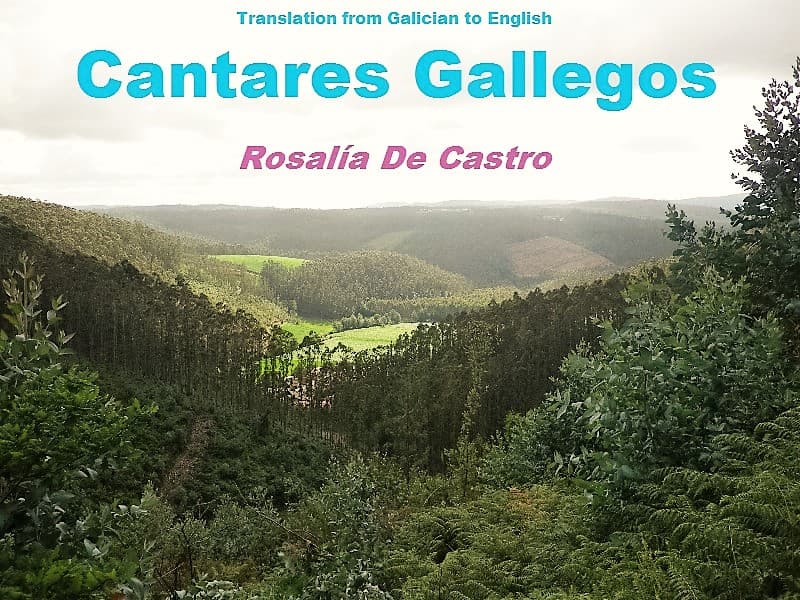
Courtesy of Alejandro Ferreiro Barreiro
Courtesy of Alejandro Ferreiro Barreiro
Author: Eduardo Freire Canosa
I grant the translations herein to the public domain
All the poems follow the index of the original edition published in 1863. The Galician title of every poem is also respected. However I have occasionally taken the liberty of writing English titles that convey a poem's content more accurately. The reason is that De Castro did not, generally speaking, title her poems, and the publishing house saw fit to assign titles identical with the first line of every poem (except for poem #34, "Alborada"). But such a procedure spawns a highly misleading index. For example the Galician title of the fifth poem, "Miña Santiña," translates literally as, "My Dear Female Saint," which might prompt the casual reader to suppose it a religious poem. It, however, blends the folklore fantasy of Halloween with a social critique wrapped in sarcasm, and this kernel warrants the fresh title, "Conversation With A Pumpkin On Halloween."
All the poems incorporate De Castro's punctuation except where this action is patently detrimental. Her style, conventional in Spain at the time, implies a profusion of commas and semicolons that would normally not translate well into English. However, since the reading of a poem entails a continual skipping of lines—with the eye blinking for a duration more or less equivalent to skipping past a comma in prose—De Castro's frequent insertion of commas or semicolons at the end of a line does not hamstring the lecture as much as it might in prose.
"Cantares Gallegos" makes extensive use of the affectionate diminutive form peculiar to the Galician language. The affectionate diminutive ends in iña (singular feminine) or iño (singular masculine). The plural variation is iñas and iños. However not every word that ends thus is necessarily an affectionate diminutive. Every poem is preceded by a tally of words that end in iña(s) or iño(s). The tally identifies which words are not affectionate diminutives and lists for those that are affectionate diminutives a range of possible translations together with a short explanation of the choice made.
The affectionate diminutive complicates the job of translating because there is no unique English resolution normally. Nonetheless to yield to the temptation of treating it as a nuisance and ignoring it altogether would deprive every poem of its full pathos. On the plus side the affectionate diminutive offers the translator an opportunity to add alliteration, internal rhyme and lyrical sharpness to the text. The objective is to find the best adjective, adverb or noun which conveys size, frailty, sympathy or endearment intended by the context. This objective normally winds down to a personal choice, which sometimes might even be to ignore an affectionate diminutive because it contradicts the context or crimps the fluidity of the translation or makes the text unadvisedly cloy. The exercise can be tedious, challenging and time-consuming, but to sideline affectionate diminutives altogether in the translation of "Cantares Gallegos" is to deprive the English reader of an approximation to what De Castro dubbed, "those tender words and those idioms never forgotten which sounded so sweet to my ears since the cradle and which were gathered up by my heart as its own heritage."
Hyperlinks to YouTube videos are deliberately few to give this presentation an academic hue.
A "livelier" abridged rendition of "Cantares Gallegos" is offered by:
Translation from Galician to English of 11 poems by Rosalía de Castro
and by:
Archived translations from Galician to English of poems by Rosalía de Castro.
The Appendix (final Index entry below) contains two poems which the translator feels do not belong to the authentic Cantares Gallegos. My contention is that De Castro wrote the poems under pressure from the publishing house which insisted on it and prescribed the subject-matter for both.
Lastly the reader may open/download the PDF version of this website by pressing the button below. Every PDF page has a nominal margin of 2 cm on its top, bottom and right-hand sides, and a wider margin of 3 cm on its left-hand side to enable binding. "Landscape" orientation is recommended for printing.
|
Get the PDF version of this website
|
Index |
|