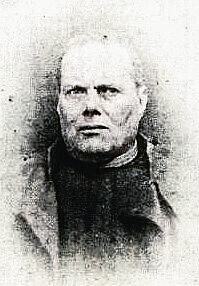
Camilo Álvarez de Castro

Camilo Álvarez de Castro.
Source: Real Academia Galega.


18.   Prejudice     (Roxiña cal sol dourado)


Background

"Roxiña cal sol dourado" is related to "Lass of the Green Mountain" (poem #14).

De Castro dedicated "Roxiña cal sol dourado" to the cantor of the cathedral of Salamanca, Camilo Álvarez de Castro. This man was the only favourable critic of Cantares Gallegos. He wrote a letter to Rosalía de Castro, dated November 12, 1864, which was "full of affection and praise for the Galician poetess." He wrote his letter in the Galician language, a very unusual thing to do at the time,

What songs, Rosalía! See, I turn them over and over as is done to flour in the sieve, and I dare not touch them, for they are carnations and would wither and lose their aroma should I touch them. After these Cantares of yours I consider you a meiga (N.T. a good witch, a wizardess) [...] and be neither sated nor silent until everybody shouts, "Maybe it's true what this wizardess says about the treasures of Galicia!"

De Castro's books of poetry succeeded in making Galicians wish to rescue their language from oblivion. As the letter explained,

I arrived to the banks of the Tormes (N.T. the river that skirts the Castilian city of Salamanca) but I did not forget the Miño (N.T. the main river of Galicia). Nor did I forget the language of my parents and grandparents telling me stories in the kitchen, watching sparks dart and the dough boil in the hearth and cinders fly upward like snowflurries to the trammel chain by the light of the oil lamp [...] That is why I read your Cantares as a hungry man eats bread, as the butterflies kiss the flowers.


Translator's Note

Some verses of "Roxiña cal sol dourado" are reverse sentences (1.1.5-7, 1.2.6-7, 1.4.5-7, 2.2.3-4, 2.5.3-4). Such sentences sacrifice logical sequencing in order to obtain rhyme or to proffer a deliberately prolix style. For example the translated sentence, "So white (her feet) they resembled two snowflakes in repose dazzling in the light of day" (1.5-7) reads in the original, "A snowflake in repose dazzling in the light of day her foot so white resembled." Reverse sentences often translate poorly into English without being rearranged.


Affectionate Diminutives

Explanation of some words, terms or expressions

co branco pé descalzado (1.1.4). The literal translation, "with the white foot unshod," is ambiguous in the English language, the girl is neither lame nor do her feet differ in colour, hence the better translation is, "with her white feet unshod." In tandem the translation turns De Castro's "copo de neve pousado" (1.1.5) into "two fallen snowflakes" (1.1.6).

cimbréase con folgura (1.4.6). De Castro uses the present tense ("sways") where the narrative's flow requires the past tense ("swayed"). The translation opts for the past tense.

cántanlle o doce a... la... lala (2.2.6). An alalá is a distinct type of traditional song.


YouTube Videos

Recital: Marga Casal Yánez.


I

Roxiña cal sol dourado,
garrida cal fresca rosa,
iba polo monte hermosa
co branco pé descalzado...
Copo de neve pousado,
deslumbrando á luz do día,
tan branco pé parecía.

As longas trenzas caídas,
con quen os ventos xogaban,
ondiñas de ouro formaban
na branca espalda tendidas;
apertadas e bruñidas,
que espigas eran coidara
o que de lonxe as mirara.

Tiñan os cores do mare
os seus olliños dormentes;
máis doces, máis transparentes,
naide os poidera encontrare;
naide velos sin amare
o corazón sin falsía
que por antre eles se vía.

Levaba na frente a ialma,
nos doces labios a risa,
auguiña que o vento enrisa,
pousaba no fondo en calma.
Tal como gallarda palma
cimbréase con folgura
a delgadiña cintura.

Ó par da brisa temprada
que antre os salgueiros corría,
ela correndo seguía
unha veiriña encantada;
que alí mansa e sosegada
manaba unha fresca fonte
cabo da falda do monte.

II

Franca, pura, sin enganos,
canta, canta, garruleira,
ó pé da verde silveira
lavando os seus brancos panos.
Ó son dos romores vanos
que nacen ca mañanciña,
lava, lava na fontiña.

Xunto dela os paxariños
gorgorexan que é un contento;
faille festiñas o vento
cos seus hirmáns os airiños.
Os pastores, coitadiños,
cántanlle o doce a... la... lala...,
que lengua de amores fala.

Ela honesta está escoitando,
mais con sospiros responde,
que aló garda non sei donde
saudades de non sei cando.
Os paniños vai lavando,
e a tendelos se apresura
nun campiño de verdura.

Dempois no rego que pasa
verte unha bágoa serena,
filla da escondida pena
que o seu peitiño traspasa,
pois que de amores se abrasa
aquela que é fresca rosa
tan amante como hermosa.

Compañeiras van chegando,
cal máis a máis ben portada,
xarros de louza vidrada
antre os seixos van pousando.
Cai a auguiña mormuxando,
brancas vinchas se levantan,
as meniñas cantan... cantan.

As estrelas van fuxindo,
a espesa niebra enrarece,
o arboriño que frorece
por antre ela vai saíndo.
O craro sol vai subindo
por riba do firmamento,
limpo, gárrulo e contento.

Arredor todo arrescende
a olido de primadera,
i aló na azulada esfera
fogax de groria se encende;
mais a meniña n'atende
sinón ao dor, ¡mal pecado!,
que ten no peito encravado.

Danlle estrañeza os cantares,
danlle de chorar deseios,
i, os ollos de bágoas cheios,
pensa nos nativos lares;
que n'hai máis tristes pesares,
máis negra malencolía,
que a que entre estraños se cría.

Paxariños, verde prado,
branca lúa e sol ardente,
todo consolo é impotente
en mal tan desconsolado;
todo contento é trubado
pola peniña sin fondo
que hai no corazón abondo.

Por eso a meniña hermosa,
foxe da alegre fontiña,
tal como triste ovelliña
que trema de dor queixosa.
Vai sentida, vai chorosa,
mentras lle cantan con saña:
"¡Da montaña!, ¡da montaña!".

I ela, que de tal se estraña,
ferida no que máis sinte,
que a maltraten non consinte,
i así lles contesta huraña:
"Anque che son da montaña,
anque che son montañesa,
anque che son, non me pesa".

I

Pretty and blonde as the golden sun,
Luscious as a fresh rose,
Gorgeous she roved through the highland
With her white feet unshod...
So white they resembled
Two fallen snowflakes
Dazzling in the daylight.

Long braids trailing down,
Which the winds played with,
Formed ripples of gold
Lying on her white back;
Taut and burnished,
Some onlooker afar would
Suppose them ears of grain.

Her lovely sleepy eyes
Owned the sea's colours;
Sweeter or more transparent
No one could find;
No one see them without loving
The guileless heart
That showed through them.

She bore the soul on the brow,
On the sweet lips laughter,
Tranquil water that the wind ruffles
Plumbed the depths peaceful.
The slender waist
Swayed with abandon
Like a glamorous palm tree.

She covered running,
Together with the mild breeze
That scampered amid the willows,
A green enchanted wayside;
For there a fresh fountain
Flowed out gentle and calm
By the hillside.

II

Sincere, pure, without duplicity,
She sings, sings, garrulous,
At the foot of the green brambles
Washing her white linen.
To the sound of the vain rumours
That are born with the early morning
She washes, washes at the dear fountain.

Next to her the little birds
Warble to one's content,
The wind with its brothers the breezes
Plays fun tricks on her.
The shepherds, poor timid ones,
Sing to her the sweet a... la... lala...,
Language that talks about love.

She is listening honest,
But answers with sighs,
For she keeps I know not where
Yearnings of I know not when.
She keeps washing the household linen,
And hastens to put it to dry
On a handy grassy patch.

Afterwards on the passing creek
She lets a serene teardrop fall,
Daughter of the hidden grief
That pierces her poor breast through,
For she broils with loves
She who is fresh rose
As much a lover as she is beautiful.

Companions start arriving,
Each new arrival the best dressed,
Setting down glazed stoneware crocks
Amid the gravel and the small rocks.
The water falls murmuring,
White bubbles surface,
The girls sing...sing.

The stars start departing,
The thick fog thins,
The flowering sapling
Starts to stand out.
The bright sun rising tracks
Above the firmament,
Clear, garrulous, content.

Everywhere the scent of spring
Perfumes the surroundings,
And aloft on the bluish sphere
Ignites a blaze of glory;
But the girl is only aware
Of the heartbreak—base sin!—
Pegged to her breast.

She finds the songs strange,
They lean her to cry,
And full of tears the eyes,
Ponders the familiar haunts of home;
For there is no sadder sorrow
Or blacker melancholy
Than the one nurtured among strangers.

Little birds, green meadow,
White moon and blazing sun,
Every solace is impotent
For so unhappy an ailment;
Every good feeling perturbed
By the intimate, fathomless grief
That abides abundant in the heart.

That is why the gorgeous girl
Flees from the dear gladsome stream
Like a poor doleful lamb
That quivers with pain, plaintive.
She leaves offended, she leaves teary-eyed,
As they chant against her with venom:
"Hillbilly! Hillbilly!"

And she, who wonders at it,
Wounded in her innermost being,
Does not consent to their abuse,
And replies diffidently:
"Although I am from the mountain,
Although mountaineer I am—
Although I am—I don't regret it."


Translation from Spanish to English of the poem "¡Volved!" by Rosalía de Castro


Edgar Allan Poe

Lenore: That Rare And Radiant Maiden