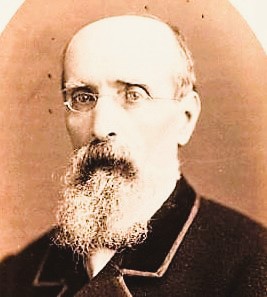
Ventura Ruiz Aguilera.
Source: Real Academia de la Historia.
Ventura Ruiz Aguilera.
Source: Real Academia de la Historia.
Background
De Castro dedicated this short poem to "the eminent poet D. Ventura Ruiz Aguilera" who in 1854 had published the Spanish poem, "La Gaita Gallega," in the collection, "Eco Nacional." Aguilera dedicated his poem to Manuel Murguía, De Castro's husband. The Galician poem, "A Gaita Gallega," is De Castro's reply. Her poem's refrain, "It does not sing, it weeps," answers Aguilera's, "I am unable to say whether it (i.e. the Galician bagpipe) sings or weeps."
The source for the following information about Ventura Ruiz Aguilera is the Royal Spanish Academy of History.
Ventura Ruiz Aguilera (1820-1881). Castilian poet, medical doctor and republican journalist. He joined the ranks of the Progressive Party in the year 1843. He published several articles in the liberal press against the Carlist monarchy movement for which he was exiled internally to a Mediterranean province in 1848. He directed two short-lived newspapers before 1852, Las Hijas de Eva and El Orden, and subsequently collaborated in many others, among them the influential daily, La Iberia. His journalism earned him several appointments to the state bureaucracy, among them the post of Director of the National Archeological Museum (1868-72). He was the author of many collections of poems: Elegías, Armonías, Inspiraciones, Cantares, Églogas e idilios, La leyenda de Nochebuena, Veladas poéticas. The collection Cantares had a great circulation and a plausible influence on the poetry of Rosalía de Castro. His most popular collection however was Ecos Nacionales. Its three parts were published separately in 1849, 1854 and 1868.
Affectionate Diminutives
Explanation of some words, terms or expressions
Virgen-mártir (1.1.6, 5.2.4). Galicia herself. Aguilera did not allude to any religious virgin in his poem, but he imagines Galicia to be "beautiful, pensive and alone, like a beloved one without her lover, like a queen without her crown" (La Gaita Gallega, 1.6-8).
Knit brilliant crowns (2.2.4). Rainbows; haloes from ice-crystal clouds.
And aye! on them sail the sons... For mercy from the homeland (3.2.1-6). The source for the following information is Cambrón Infante.1
By the early 1830's the Spanish colonial authorities of Cuba, the landowners and the sugar exporters realized that the growing population of African slaves posed a serious threat to the stability of the Caribbean island. In 1853 slave trafficker Urbano Feijóo Sotomayor and captain general Valentín Cañedo elaborated a White Paper to fill the demand for slave labour in the sugar cane plantations of Cuba with Galician workers brought in under a five-year contract. The plan was approved by the Spanish Courts on May 2, 1854. Earlier in March the frigate Villa Neda had already transported the first 314 Galician workers to Havana. The official plan promised a decent life in Cuba. The reality turned out to be quite different... Upon arrival the employer secluded the workers in barracks lacking the minimum living conditions and hygiene; this was to be their residence during a period of "adaptation." The barracks were in fact derelict venues where landowners flocked to buy workers: a marketplace for buying and selling human "cargo." The food provided was sparse and dismal—potatoes and salt-cured meat—and the period of "adaptation" lasted for as long as it took to negotiate the price of a worker with slave trafficker Feijóo. Ramón Fernández Armada the director of the Havana enterprise resumed the situation thus,
The Galicians were taken from their homes tricked with false and vague promises and have arrived in Cuba to find opprobrium, fraud, ignominy and death. Until now approximately 500 have died from hunger, ill treatment or as a result of being abandoned [...] Their entire blame consisted in asking for bread to avert starvation; and to restrain the [rebellious] impulse the bosses ordered that they should be held in foul-smelling quarters, chained and fettered, naked and barefoot. They feed them rotting meats which the African blacks reject. They force them to work fifteen hours daily by way of the whip, the stick and the sword. This situation has led them to despair and the ones who did not escape died in the byways, the jails or the hospitals. A scandal—horrendous—a slaughter.
A third of the Galician emigrants died in Cuba during the first three months of the Feijóo project. Toward the end of 1854 news arrived to Galicia about their desperate situation,
We are treated worse than the slaves, sold like them to employers. Feijóo has outraged humanity and nature by re-establishing slavery.
aló nas Castillas oias (5.4.2). The administrative division of Spain by Secretary of State Javier de Burgos in 1833 created two regions called New Castile and Old Castile.
YouTube Videos
| Recital: C.P.I. do Toural. |
|
I
Cando ese cantar, poeta,
En vano a gaita tocando
que eu podo decirche: II
Vexo contigo estos ceos,
Vexo esta terra bendita
Mas, ¡ai!, como tamén vexo
Anque mimosa gaitiña
eu podo decirche: III
Falas, i o meu pensamento
I, ¡ai!, como nelas navegan
Anque contenta a gaitiña
eu podo decirche: IV
Probe Galicia, non debes
Naide por que te levantes
Galicia, ti non tes patria,
Por eso anque en son de festa
eu podo decirche: V
«Espera, Galicia, espera»
Págueche Dios, bon poeta,
Págueche este cantar triste
E cando a gaita gallega
que a gaita gallega: |
I
Poet, when you intone that song
In vain the bagpipe playing
That I can tell you: II
I see these skies as you do,
I see this blessed land where
Yet aye! I see also
Alhough a native bagpipe may play
I can tell you: III
You speak, and my fancy beholds
And aye! on them sail the sons
Alhough the poor bagpiper plays
I can tell you: IV
Poor Galicia, you must never
No one extends a kind hand
Galicia, you have no fatherland,
Thus though in festive tone gay
I can tell you: V
"Wait, Galicia, wait." How much
May God recompense, good poet,
May God recompense this sad
And when you hear the Galician
That the Galician bagpipe |
Eduardo Pondal |
| Translation from Galician to English of 11 poems by Eduardo Pondal |
Manuel Curros Enríquez |
| Translation from Galician to English of 4 Classic Emigration Ballads |